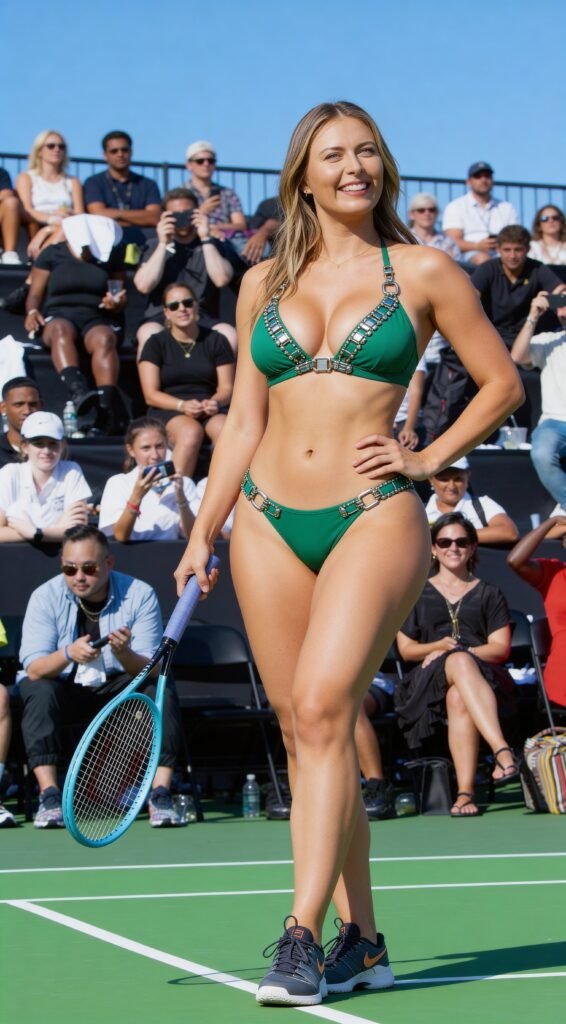
Few athletes have ever combined sheer competitive fire, global celebrity, and long-term business savvy quite like Maria Sharapova. From a freezing industrial town in western Siberia to the grass of Centre Court, from five Grand Slam trophies to running her own venture fund — her journey is one of the most striking in modern sports.
She was born Maria Yuryevna Sharapova on April 19, 1987 in Nyagan, a remote city in Russia’s Khanty-Mansi region. Her parents had moved there from Belarus hoping for better work during the late Soviet years. When Maria was two the family relocated to Sochi on the Black Sea coast — a warmer place that would unexpectedly become the launchpad for her tennis career.
She first held a racket at four. Her father, Yuri, had played some tennis recreationally and recognized very early that his daughter had unusual hand-eye coordination and focus. At six she caught the attention of Martina Navratilova during a tennis exhibition in Moscow. Navratilova told Yuri that Maria needed serious coaching and should go to the United States. A few months later — at seven years old — Maria and her father arrived in Florida with very little money and almost no English. Her mother, Yelena, stayed behind because of visa problems and mother and daughter were separated for two years.
They joined Nick Bollettieri’s famous tennis academy. Maria lived in a dormitory, trained for hours every day, and spoke almost no English. She has said many times that those years were lonely, but they also forged the mental toughness that later defined her.
By age eleven she was winning national junior titles. At fourteen she turned professional. The tennis world really noticed her in the summer of 2004. Still only seventeen and ranked outside the top 50, she qualified for Wimbledon, then stunned the sport by defeating two-time defending champion Serena Williams in the final. She became the first Russian woman to win Wimbledon and the third-youngest champion in the tournament’s history. Overnight she was a global name.
The next decade was a remarkable run:
- 2006 US Open champion
- 2008 Australian Open champion
- 2012 French Open champion
- 2014 French Open champion (completing the career Grand Slam)
- Olympic silver medalist in singles (London 2012)
- 36 WTA singles titles
- 21 weeks ranked world No. 1 (five separate times)
She was known for an aggressive baseline game, one of the most feared serves on the women’s tour, a punishing forehand, and extraordinary mental resilience in big matches. Off the court her looks and marketability made her the highest-paid female athlete in the world for many years running. Nike, Porsche, Evian, Tag Heuer, Head, and dozens of other brands signed long-term deals. She also created Sugarpova, a successful candy line that later evolved into a broader sweets brand.
Then came the biggest storm of her career.
In March 2016 she announced that she had tested positive for meldonium at the Australian Open. The substance had been added to the prohibited list only weeks earlier. After a long hearing, the Court of Arbitration for Sport reduced her initial two-year suspension to fifteen months, accepting that she had not intended to cheat but had failed to update her medication protocols when the rules changed. She missed the 2016 Olympics and most of two seasons.
She returned in 2017 and reached the quarterfinals of the 2018 US Open, but recurring shoulder injuries made playing at the highest level increasingly difficult. After multiple surgeries and long rehabilitation attempts, she announced her retirement in February 2020 at age 32.
In her retirement letter she wrote: “Tennis has given me so much — a life I never could have dreamed of as a little girl in Siberia. It has challenged me, shaped me, and taught me lessons I will carry forever.”
Since leaving the tour she has moved into investing and entrepreneurship. In 2022 she co-founded Supernova, a venture-capital firm focused on early-stage companies, many of them founded or led by women. She has invested in health, wellness, technology and consumer brands. She continues to appear as a brand ambassador, speaker, and occasional television commentator.
In 2022 she married British businessman Alexander Gilkes in a private ceremony in Turkey. In 2024 they welcomed their first child.
Looking back, Sharapova’s impact on tennis goes beyond her titles. She helped make women’s tennis more visible in Russia and Eastern Europe, showed that an athlete could dominate commercially without sacrificing competitiveness, and demonstrated how to transition successfully into a second career after sport.
She was never the most naturally gifted mover on the tour, but she was among the most determined. That combination — fierce work ethic, mental strength, and willingness to take big risks — carried a seven-year-old from a Siberian apartment to the top of the world, and then carried her into a completely different kind of success after the racket was hung up.
At 38 she remains one of the most recognizable and respected names in sport — proof that the qualities that make someone a champion on the court can also build a meaningful life long after the scoreboard goes dark.